Our live radio broadcasts are currently on hiatus while we work on improvements to Sanitarium.FM's core services. For further information, visit our Discord.
Forged by creators of the Tekken and SoulCalibur franchises, Rise of Incarnates unleashes unfettered 3D combat upon the PC.
In this shattered landscape, Incarnates team up for 2v2 battles within famous cities that have been realistically recreated as they vie to determine the fate of the world. Run and fly through true 3D environments as Incarnates awaken untold powers – Ares, Lilith, Mephistopheles, Grim Reaper, and more await your command.
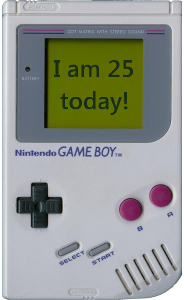
Around this time in 1989, this big grey brick to the left started to hit the shelves in a move which would revolutionise the way we play videogames. A bulky, squarish device capable only of greyscale graphics; and requiring no less than FOUR AA batteries to power (for these were the days when internal, rechargeable batteries were unheard of – though a later model, the “Game Boy Pocket”, would later slim down the console and reduce the power requirement to a more reasonable two AAA batteries), the Game Boy was a hand-held games console that, while neither Nintendo’s first foray into hand-held gaming nor the sole entrant in the market in its era, brought the idea of gaming on-the-move to mainstream attention; while its games, such as the still-addictive-today Tetris and the forever evolving, eternally popular juggernaut Pokémon would bring new emphasis to the concept of “accessible to all” and “better with friends” gaming respectively. And now, this piece of gaming history is 25 years old.
Cut me a slice of that cake – and let’s go grab a round of drinks.
Part of the team behind Civilization V and its many successors are now using the same engine they built for those games for a new spin-off title, which while part of the Civilization franchise is also intended to stand separate from the main series games. Called Civilization: Beyond Earth, the name alludes to its core conceit – taking the concept of Civilization intergalactic and seeing you settle not Earthen lands, but a whole new alien world.
Sounding familiar? The idea of colonizing an alien planet through the medium of turn-based strategy has certainly been seen before – over ten years ago, in fact, in cult classic Alpha Centuri. But even though the concepts may be similar, the team baulk at suggestions that their game is in any way a successor, pointing to numerous significant differences between the two titles.
Chief among these is that Beyond Earth doesn’t just follow the history of a single planet. “Our story begins with hundreds or even thousands of colony spaceships leaving Earth for potential new planets during an event called the Seeding,” explains Dave McDonough, one of the many members of the game’s Design team. “The idea is that every time you play a game, you pick up the story of one of those planet settlements.” Indeed, the Sci-Fi theme of the game and lack of focus on a particular planet offers the team an unprecedented freedom in defining the history of the lands you’ll play – something that, according to producer Dennis Shirk, is being taken full advantage of.
“When you started out in Civ V and you had Genghis Khan on one side of the map and Montezuma on the other, you had a very good idea of what your game was going to be like. Lots of pain and suffering, burning cities (laughs) … But because Beyond Earth is a total sci-fi game and we can do what we want, the leaders will have distinct personalities, and a flavor to them, but wanted each experience to feel completely different.”
Before you get taken to your randomly-chosen planet and begin to colonise it, however, you first have to make preparations back at Earth for your trip. This involves you deciding on what equipment to take with you; and setting up the faction you’ll be representing. You have a choice of eight factions, each completely distinct from each other; but that isn’t the limit to your choices – players can choose their colonists, cargo, and choice of spacecraft during the seeded start. The team are eager to give players the ability to customise their game however they like; and every decision affects the scenario you’ll end up with when the game officially starts.
“The factions do have named leaders that are representatives of their group. But the identity that your faction has is much more under your control. The first thing you do in the game is customize the colony ship and the expedition itself, and the faction leader is just the first step in that process.” – Dave McDonough
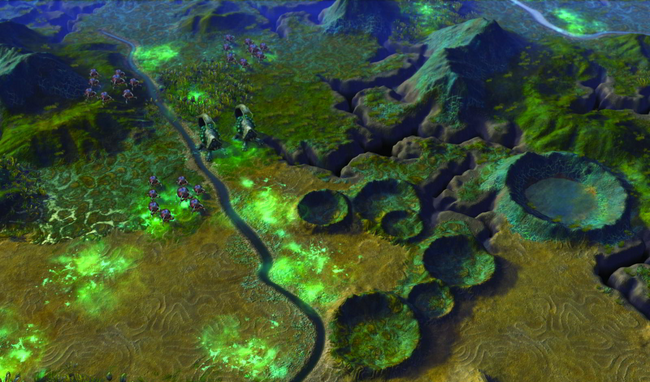
Speaking of the planet you’ll be colonizing, Civilization: Beyond Earth will make a strong attempt to emphasise the “alien” nature of your new territory with a wider range of geographical features, including some very strange structures. The game is taking a different approach in its mechanics as well. No longer will your technological advances follow a generally linear pattern; instead, Civilization: Beyond Earth is adopting a branched approach. A “technology web” will see you choosing to develop technology through three main branches, each of which ultimately leads to a different win condition for the overall game – but the team is keeping mum on the details for now.
Finally, the orbital satellite system is being overhauled. You’ll now build them like any other unit, so you’ll need to manage your resources effectively. When placed on the map, they can give passive bonuses like adding to research or food production, buff ground forces or help with terraforming, give a small combat ability or increase your field of vision. The satellites will degrade over time and eventually fall to orbit and explode, so they can’t be permanently relied on – though hopefully by the time they’re lost, you can replace them with better kinds. To make matters worse, your enemies will also be able to shoot them down. So investing heavily in satellites comes at a huge risk/reward dynamic.
Multiplayer is also already in the works for the new title, with the quality assurance teams already playing multiplayer matches against each other, although features are still being planned and implemented. Nevertheless, Shirk says the Multiplayer element of the game “will be ready for action when the game ships”.
Will Civilization: Beyond Earth also take a different approach to storytelling? Alpha Centuri was memorable for its approach to telling the story of its game world as you played, with an over-arching story that would be slowly introduced to you via text interludes as the game progressed that detailed the growth of the planet’s sentience. According to the team of Beyond Earth, we won’t see a strong overarching storyline here which leads the game down one single path; instead, a quest system will allow more emergent and random storytelling to take place. “Some of the early quests are based around exploration, or building your first new settlement, while others are complex, multi-part quests which feed into the victories within the game. They also help convey some information about the game and world to the player, and help people keep track of their progress towards victory,” they said.
But whether or not Beyond Earth comes to be seen as either Alpha Centuri or a truly original title, the very idea of taking Civilisation to outer space and playing a turn-based sci-fi game that’s based on a single planet, which is chosen by your early decisions and evolved through your actions within it – rather than jumping from system to system – is extremely exciting.
Colour me confused. As we all know, the Gamepad controller that forms the main gimmick of Nintendo’s Wii U console, incorporates with it an NFC Reader. Back when this was first announced, many of us assumed this would allow NFC-enabled toys, for example Skylanders figures, to work on the console without the need for a separate device (the Skylanders Portal, for example). Indeed, Nintendo even made numerous references to such functionality in a subsequent Nintendo Direct – but despite this; and even as Skylanders games continue to make a presence on Nintendo’s consoles and the 3DS, this ability simply hasn’t been utilised.
Why not? Surely Skylanders’ child-friendly nature, emphasis on collectivity and vast array of funny characters is a natural fit for Nintendo – so the company should be trying to support them as much as they can right? Well apparently, Nintendo was “confused” about the whole concept of Skylanders when they were first told about it – and that confusion led to them pulling out of a potentially lucrative deal, according to Fred Ford and Paul Reiche, co-founders of Skylanders developer Toys For Bob.
Speaking to the gaming website Polygon as part of a larger Skylanders feature, the two developers revealed that the company approached Nintendo to discuss Skylanders in the hopes of getting the company behind them during early development of their big toy-centric action game. They believed the title fit in with Nintendo’s own family-friendly image and childlike charm; and at one point even discussed combining Nintendo properties into the Skylanders game world – could you imagine Mario, Zelda or Samus standing beside Spyro and the other Skylanders? However, Nintendo appeared confused by the concept.
The company’s lack of understanding over what Skylanders was supposed to be and how they’d work with it, appears to have led to Nintendo deciding not to commit to the IP. To this day, Toys For Bob remain confused as to why Nintendo didn’t give them a chance. Said Reiche: “Clearly, they have got properties well suited to this world. Why it is that they didn’t rush in here will probably haunt them for the rest of their days.”
Indeed, Skylanders has gone on to sell millions of games and hundreds of millions of the individual figures over its relatively short lifespan; and now has three separate series. Whether you’d like to admit it or not, the franchise has become an enormous global success – a fact that must hit Nintendo hard given their recent financial woes. Perhaps this could be behind recent rumours that Nintendo may be looking into turning its own virtual, toy-based series, Pokémon Rumble, into an actual physical toy line? Of course, these are just rumours right now – but you gotta admit, it makes a ton of sense; and Nintendo do have a history of showing people how things should be done…
With more and more gaming moving towards digital distribution, downloadable content and online features, Capcom has decided it needs to make a serious investment to keep up and succeed in a “challenging” video game market. To this end, the videogame developer/publisher titan – popular for franchises such as Resident Evil and Dead Rising – has announced it is to spend the equivalent of around US$78 million to build two new R&D labs near their Osaka headquarters, focusing on the new trend.
“The appearance of next-generation consoles with a variety of network functions has shifted the focus of sales from conventional package software to digitally distributed content,” Capcom said. “The profit structure and business model are changing at an increasing speed as a result. Furthermore, the popularity of social games due to the widespread use of smartphones is enabling games to reach more user segments and enlarging the entire game market. To succeed in this challenging environment, Capcom has been focusing resources on strategic and growing areas under a policy of selection and concentration in order to operate with speed and flexibility.”
Capcom are fitting out their two new buildings with all kinds of modern technology that’s come into common usage in the videogames of today, including rooms dedicated to motion-capture technology; and a sound effects studio. They’ll also contain large, multi-purpose communal spaces for gatherings of over 100 people. With these, the company hopes to speed up game development and increase efficiency. The buildings will also have seismic isolation systems to protect against earthquakes.
The smaller building, currently nicknamed “R&D Building S”, will on completion consist of an 8-floor office with 2,054.38 square meters of floor area; and will cost an estimated ¥2.5 billion ($24.6 million) to complete, which Capcom aims to do by January 2015. Its bigger brother, “Building N” is over twice the size, with 16 floors and 10,972.87 square meters of floor space. Expected to cost around ¥5.5 billion ($54 million), this one should be ready in February 2016.