Your Sanitarium.FM Account
|
Today
- 6am - Auto DJ
- 9am - Auto DJ
- 12pm - Auto DJ
- 3pm - Auto DJ
- 6pm - Auto DJ
Support The Sanitarium.FM! 
Or donate to us via PayPal:
|
|
Sanitarium.FM, the station the voices in your head want to listen to!
|
|
 |
If you’re a serious gamer, you’ve undoubtedly heard of DirectX. With a rich history spanning over 20 years, Microsoft’s home-grown graphics controller and drivers are still used in many games today – particularly those targeted at consoles and Windows PCs – to enable visual splendour, capable 3D graphics and more. But while it may remain a popular technology, the last version of DirectX officially launched by Microsoft, 11.1, was last updated in 2009. Five years later, with devices becoming more powerful and capable, the technology’s age has begun to shine through, leading many developers to ask Microsoft to supply the tools to take DirectX further and extract the most out of any hardware the games end up on.
According to Microsoft’s DirectX Developer’s site, the company is finally set to deliver on that promise. In a sponsored session at this year’s GDC, entitled “DirectX: Evolving Microsoft’s Graphics Platform”, Microsoft’s development manager for graphics at Microsoft – Anuj Gosalia – is set to reveal the company’s plans for DirectX12. The official GDC website offers the following description of that talk:
For nearly 20 years, DirectX has been the platform used by game developers to create the fastest, most visually impressive games on the planet. However, you asked us to do more. You asked us to bring you even closer to the metal and to do so on an unparalleled assortment of hardware. You also asked us for better tools so that you can squeeze every last drop of performance out of your PC, tablet, phone and console. Come learn our plans to deliver.
Nothing is yet known about what Microsoft plan to reveal – besides the increased power alluded to in the above description – but the talk appears as one of a number of DirectX-related talks planned to be hosted by Microsoft this year, which also apparently includes a talk on the future of Direct3D; and eight talks related to the current DirectX 11.
Stay tuned for more news as we hear it.
March 6th, 2014 by CrimsonShade |
| Posted in Gaming, General, Technology | No Comments » |
|
Four years ago, a new service called OnLive debuted, offering a whole new way to play and get games using online streaming. Rather than downloading games or buying them from stores, you streamed them from online servers and paid for the access rights – meaning low-cost, no-storage-required gaming that just required a solid internet connection and which promise to revolutionise the way we played games. The reality, however, was far less rosy. By marketing itself as its own platform – alienating both publishers who worried about game sales cannibalising those on established platforms, and players who were forced to decide whether to buy their games traditionally, via OnLive, or both; selling some games itself – cutting it off from retailers; and giving developers an extra step in the development process to support the platform, OnLive made an enemy of practically everyone; and in 2012, the company folded, its assets sold off and all the staff laid off.
Now though, OnLive is back and learning from its mistakes, thanks to a relaunch in the hands of the buyer, a new (legally-speaking) company also called OnLive. After 18 months out of the limelight, OnLive has returned under new management and carrying two new business models.
The key to the new OnLive is a brand new offering called Cloudlift. Thanks to a partnership with Valve, OnLive now has access to the full library of Steam games, bringing thousands of games of all different kinds to the platform. OnLive will now let you buy Steam games and add them to your Steam account through the service, solving the platform separation by potentially allowing the same game to run on multiple devices through both OnLive and Steam itself. The magic comes with OnLive’s streaming abilities. Once again, when playing a Steam game through OnLive, you won’t actually be downloading and playing the game locally – instead, the game is streamed to you over an internet connection from super-fast, super-capable servers hosted by OnLive, meaning no storage is required. In a genius touch however, slam in your Steam account details and as long as you’re using Steam’s Cloud Save feature, Cloudlift will grab your online save for each game as you load them up, so you’ll be able to continue the same game you have on your traditional Steam-enabled device. If you have a solid internet connection (2mb/sec minimum, 5mb recommended download speed), you may never notice the difference.
As Cloudlift is available as a smartphone app and as software for PC and Mac, the service potentially will allow Ouya and other Android-based consoles to get the full range of Steam apps and play them with high performance, instantly increasing their usefulness and the size of the game libraries; and also potentially means a game you start on your PC can be later played on the Mac at work, with little change in performance even if the power of all the devices is completely in different leagues – all you need is a compatible controller. Cloudlift comes with a heavy price tag, however, at $14.99 and £9.99 per month; and with only Steam games on offer at the moment, the choice is limited to your already-purchased and future-purchased Steam Games; you don’t get a whole range of games included in the price like with movies on Netflix. Along with this is the problem that not all Steam games come with cloud sync, meaning they can still be streamed but won’t allow players to pick up where they left off.
Luckily, OnLive are not resting on their laurels, as they have two additional plans in the works to increase the game library as they come along. First, the original OnLive game library will soon be relaunched, meaning the company will once again start sellings its own games too. While this will remain a separate service to Cloudlift for now, any games bought from OnLive will also come with seven days’ access to the same game on Cloudlift – whether this feature will remain or be enhanced in future however is yet to be seen, as the company are not committing heavily to the OnLive market to prevent it repeating its past mistakes. OnLive is also allowing games publishers to partner directly with them and deliver demos of their games to stream through the services, which will be a white-label service – so the publishers are free to credit the games however they like (expect names like “Sega Go” or “EA Live” to crop up, for example). Gaijin Games are one of the partners named to be on board.
Will the new strategy allow OnLive to succeed where it once failed? And will full online streaming become the future of, or a strong alternative to, both digitally stored and physical media gaming? Time will soon tell.
March 5th, 2014 by CrimsonShade |
| Posted in Gaming, General, Multiplatform, Technology | No Comments » |
|
“Internal experiment” may pave the way to free, Chromebook-inspired Windows rethink.
Microsoft is at a crisis point. With calls to ditch their home-grown Surface line of tablets due to lack of sales; new installs of Windows 8 selling at a slower pace to its still-popular predecessor Windows 7 – to the extent that some PC makers now offer Windows 7 on their PCs instead and 8 as an optional upgrade; and a lack of smartphones being launched by third parties running Windows Phone 8, the company is forced to look at new strategies to drum up sales.
At the hands of new CEO Satya Nadella, it appears Microsoft are already on the works on this new strategy; and it may involve lowering licensing costs and setting less restrictions on using its systems in order to make them cheaper and easier to get onto more devices; thus expanding reach by targeting more markets including the lesser-tapped low-end market. Already we’ve seen Microsoft working on a new low-cost smartphone range with the Nokia X Phones; and rumours suggest Microsoft may even consider lowering the licensing cost for Windows Phone itself by as much as 70%, to make it more affordable for phone manufacturers to put on their models. Now, it sounds as if Windows 8 itself might get the same treatment.
According to reports by The Verge, Microsoft is experimenting with a new version of Windows 8 known as “Windows 8.1 with Bing”. This experimental rethink of Windows 8.1 is said to put Cloud services first, even more than Windows 8.1 does already with its SkyDrive OneDrive integration, emphasising services such as Office Online and Bing Maps, etc; in order to drive monetization through use of those, rather than through up-front software costs. In fact, the use of the Bing trademark in its name – which is also the name of Microsoft’s home-grown search engine and services linked around it like News, Maps, Social and so on – suggests Windows 8.1 with Bing could be geared mainly towards a browser-based environment and use of the Cloud as a platform, so what we could end up with might look a lot like Chromebooks, which seems to be Microsoft’s main competition of late.
The intention of Windows 8.1 with Bing could be to offer those still sticking with Windows 7 a free or low-cost upgrade to encourage them to consider upgrading to the latest OS; while allowing them to recoup the loss of licensing revenue through subscriptions to Microsoft’s online services. But other rumours suggest Microsoft is also pitching it to device manufacturers as a cheaper alternative for those devices where the cost of licensing traditional Windows would severely eat into profit margins due to low retail prices. Microsoft may reduce or even eliminate the licensing cost for devices priced below $249 if they run Windows 8.1 with Bing instead of a full-fat variety; this claim fits nicely with a previous rumour from The Gadget Show that Microsoft were looking at reducing Windows licenses to $15 on such products.
With the system said to be experimental, however – and with Microsoft yet to confirm, deny or even comment on the rumours – there is no guarantee as of yet that Windows 8.1 with Bing could ever become an actual product or is being considered for such. But with Google Chromebooks, Android and Mac OS X all eating into Windows’ market share due to the lack of any licensing costs – though only on older versions, in Mac OS X’s case – it makes sense that Microsoft may be considering such a move to remain relevant in 2014 and beyond. Only time will tell what becomes of these as-yet unconfirmed rumours.
March 1st, 2014 by CrimsonShade |
| Posted in General, Technology | No Comments » |
|
While WhatsApp might be the most popular Mobile Messenger app in most of the world, in Japan there’s another name that’s making waves in the local market. Called Line, it works in a very similar way to WhatsApp; and given its success in its native Japan, the company is now gunning for global growth.
Line’s mission may have just had help in its goal thanks to this week’s occurrences to WhatsApp itself. After selling to Facebook for a proposed $19 billion in combined cash, stock and incentives, WhatsApp’s servers suffered a 210-minute outage that prevented people using the service, which many wrongly interpreted as Facebook either closing or doing behind-the-scenes work on the app following the purchase (more likely it was simply server overload). Following the deal and subsequent outage, Line saw its registered user account increase by over two million users over the next 24 hours, which Line claim is five times its usual user acquisition rate outside its home region of Asia, and specifically in North America, South America and Europe.
Following the news, the CEO of LINE Euro-Americas, Jeanie Han, issued a statement about the increased growth which makes a number of jabs at WhatsApp’s outage:
“Our growth strategy has always included providing a strong network that can handle unplanned and unexpected increases in network traffic … We pride ourselves on providing a safe, secure platform that will always work when our users need it the most.”
But Line isn’t alone in benefitting from WhatsApp’s woes. A third Mobile messaging app, Telegram, saw its user acquisition rate spike 3x after WhatsApp’s Facebook acquisition was announced – propelling it to the top of the App Store rankings and bringing it some 8 million new users in a handful of days. Many other similar apps also saw smaller growth levels, so it seems Mark Zuckerberg’s big spending may once again bite both Facebook and their new acquisition in the ass – at least for now.
February 27th, 2014 by CrimsonShade |
| Posted in General, Technology | No Comments » |
|
Before Microsoft bought out Nokia’s mobile division, rumours were spreading that Nokia planned to release phones running versions of Android as a new investment in the company’s future. Indeed, pictures released online of a supposed new Nokia phone seemed to show that a prototype was at least being worked on prior to or during the deal taking place. However, with Microsoft having its own, long-established mobile OS in the form of Windows Phone; and with Google, who “owns” Android, being a major rival to Microsoft, it’s fair to say a lot of us saw Microsoft as putting paid to that plan with their buyout.
Last night, at the start of the Mobile World Conference, the new Microsoft-owned Nokia phone division took to the stage… but to our surprise, it WASN’T to promote the existing Lumia range of Nokia-branded Windows Phones. Instead, what was revealed was a new range of smart phones, known simply as “X”, which run… Android?!?
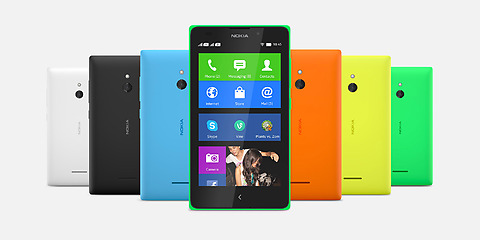
Pictured above: The Nokia XL with the customised Android Build on display. Other phones in the X range have a smaller profile, but all run the same system and have the same choice of colourful backplates to select from.
The announcement comes only a short while after Microsoft announced its willingness to keep Nokia’s legacy alive and allow Windows phones to target lower as well as higher-end markets, following Nokia’s own established business practices. However, there’s no plans for the X range of phones to hit major markets like US, Korea and Japan – the X line is apparently geared more towards the emerging markets of lesser countries, where interest in new technology is high but the economies are low (which probably rules out the UK too, but nothing’s been said there yet).
The phones themselves take a lot of design cues from the pre-existing Nokia Asha 503, consisting of the same matte polycarbonate chassis but without the transparent crystallic case surrounding it. So far three models of the phone have been announced: The X phone – out right now for 89 Euro – is 10.4mm thick and sports a 4-inch LCD screen with 800 x 480 pixel resolution, a 3-megapixel camera, a 1GHz dual-core Snapdragon processor, 1,500mAh removable battery, 4GB of internal storage, a microSD expansion up to 32GB and 512MB of RAM. For ten Euro more, Nokia will soon release the X+, which bumps up the RAM another 256MB and comes with a 2GB microSD card included, but is otherwise exactly the same. Finally, announced for the second quarter of 2014, the third model is the XL, which sports a five-inch screen, TWO cameras – a 5-megapixel rear snapper and a 2-megapixel front with an LED flash, 768MB of RAM and 4GB of built-in storage along with the microSD support. This has an expected retail price of 109 Euro. All three phones are dual-SIM, so separate SIM cards can be utilised for phone and data plans – a practice common in these emerging markets.
While the new Nokia X phones may run Android, however, they’re far from a pure Android experience – instead, the whole experience has been customised using a mix of Microsoft and Nokia’s own design cues, resulting in an experience that, perhaps unsurprisingly, looks similar to Windows Phone. As you’d also expect, this customised Android experience also ditches all the usual Google services with Microsoft or Nokia-branded alternatives – the sole exception being the internet browser, which is built on a mobile version of Opera. The X launcher consists of a series of neatly lined-up tiles; and unlike Windows Phone, which only recently added folder support via add-ons released by Nokia itself, the X line has folder support built-in for those who like to keep their apps organised. Keeping with the “similar to the Asha” theme, the X phones also have Fastlane; here it takes the form of a side menu which is the X’s version of a notification menu; and logs most-used apps, nearly all of your activities, open apps and background processes on the same page in a neatly organised manner.
The new X phones even have their own App Store, in the Nokia Store. This store contains modified versions of Android apps specifically designed for the X line of phones, but Nokia say a developer needs to add no more than a few extra lines of code to a standard Android app to make it compatible. Nokia then curate the store, deciding if apps go in or need changing. But if the app you’re looking for is nowhere to be found in the Store, a screen pops up with suggestions for other third-party app stores which should feature that particular title. Nokia also claim that as the X phones are built around Android’s OSP, sideloading APKs and apps are also possible, potentially allowing anything to run that would run on a standard Android phone – and I’d put money down on resourceful developers calling their bluff soon enough.
Nokia also state that the system itself; and the individual apps contained within will receive regular updates according to consumer demand, which should act as a reassurance that the phone won’t lag behind current Android releases or end up stuck on the same version forever – a common problem with Android phones – unless it sells badly. Honestly, this is an article I never expected to write and it colours me as quite impressive, but will it come up trumps for Microsoft and Nokia? And if it does, will it be at the expense of Windows Phone itself? Only time will tell.
February 24th, 2014 by CrimsonShade |
| Posted in General, Technology | No Comments » |
|