Our live radio broadcasts are currently on hiatus while we work on improvements to Sanitarium.FM's core services. For further information, visit our Discord.
The Independent Games Festival announced the nominees for the awards they hand out to the best of the best annually, from the indie game offerings of 2013 yesterday. In the running are various stand-out titles such as Papers Please, Don’t Starve and DEVICE 6, as well as other titles that haven’t had such a wide audience.
The awards include categories such as Excellence in Visual Art, Narrative and the Seumas McNally Grand Prize all which list 6 nominees and a handful of honourable mentions in each category, with finalists having the opportunity offered to them of a distribution deal with Steam for their game (if they don’t have one already). The awards themselves will be taking place on the evening of March 19th at the San Francisco Moscone Convention Centre, preceding the Game Developers Choice Awards which recognise excellence across all gaming development.
We’re in the midst of CES 2014’s gadget and computer hardware information avalanche and it’s starting to get a little difficult to separate the exciting announcements from the announcements we’ll forget about before the show’s over. For example, how do you feel about Razer’s announcement of Project Christine, a modular gaming PC? I mean, look at it. That doesn’t look like any PC I’ve ever seen. Where’s the dust-clogged exhaust fans, the fire-hazardous tangle of cables, and the unsightly, space-inefficient case?
Apparently, Razer has been working on this for two years. The idea is to eliminate one of the most prohibitive aspects of PC gaming—installing new components. Okay, we agree that plugging in a new graphics card or more RAM is not that difficult, but the sight of an exposed motherboard does fill some with debilitating fear. It’s why a lot of people buy consoles. They are simple, plug and play consumer devices that just work. Mostly.
Project Christine will allow you to plug in any optical drive, extra storage, GPU, or CPU, each of which is encased in a proprietary, water-cooled module. All parts will plug into the PCI-express, SLI enabled “backbone.” Need a better graphics card? simply buy a new module and exchange or add it to your existing one. That does sound convenient, and ideally it’s a foolproof system which makes upgrades quick and easy.
The machine is supposedly very quiet, without cables, and its touch LCD screen displays control and maintenance information. Razer didn’t say how much more expensive these modules are when compared with their regular counterparts, or if it will allow other manufactures to sell them.
Actually, it seems as if Razer is still undecided about a lot of the details here. As CEO Min-Liang Tan told The Verge, the goal of the announcement was to “throw it out to gamers and see if people like it.”
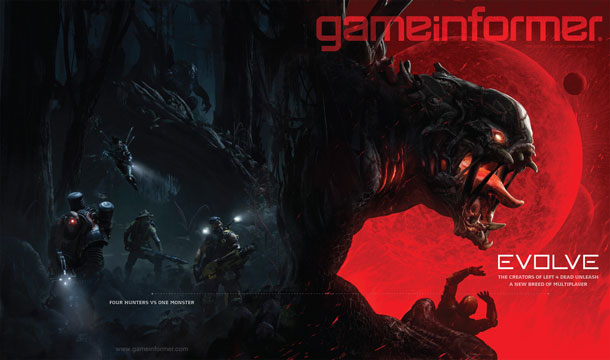
Evolve is a new co-op shooter from Turtle Rock Studios, the same people that brought you the post-apocalyptic hit Left 4 Dead. The February issue of Game Informer will feature a 12-page spread on the upcoming title that is described as a…
…sci-fi multiplayer-focused shooter pits a four-player crew of alien hunters against a separate player-controlled monster that grows larger and more powerful over the course of matches. Each hunter features its own unique items and abilities, and while the monster may be outnumbered, its size and an assortment of devastating attacks make it a more than formidable foe.
-Game Informer
Evolve is slated to release on PC, Xbox One, and PlayStation 4 this fall.
Well here’s some big news on one of the year’s most anticipated games. Titanfall only supports a maximum of 6 vs 6 players during online play.
Answering a fan query on Twitter, Respawn Entertainment’s Vince Zampella confirmed the news, saying that this, “turned out to be the best balance with AI for us.”
So how do you fill a map that only has twelve players in it? With AI soldiers. Zampella didn’t confirm exactly how many AI soldiers would be included, but did say it’d be “enough to make it fun,” before adding that it’s the players who are “the real threat”.
Zampella also added that every player can have a Titan with them, which he says will make firefights feel busy
“It is incredibly fun, we did a lot if testing. It is all about what we found most fun,” Zampella concluded.
Titanfall is an online only game and will therefore not include a campaign.
The game is due for release in March on PC, Xbox 360 and Xbox One
Facebook, the popular social network with over a billion users world wide, has just been hit with a class-action lawsuit. The allegations, revealed in the FT, are that Facebook systematically scans the content of private messages so it can sell the data to third parties such as advertisers.
Facebook’s entire business model is based on the fact that it monitors what users write, like and up-load in order to sell this information on to others. In principle, there is nothing wrong with Facebook using our data to make commercial gains. In the end, the service is free and Facebook has to make money somehow. However, my biggest concern is that the data mining activities are not as transparent as they should be.
Facebook has been criticized for this lack of transparency on many occasions, but two Facebook users now believe Facebook has gone too far. Users Matthew Campbell from Arkansas and Michael Hurley from Oregon have filed a class-action lawsuit on behalf of the over 166m Facebook users in the US. The accusation is that Facebook is violating the Electronic Communications Privacy Act by scanning and exploiting the content of private messages sent via the Facebook platform without prior consent by users.
The issue here is that ‘private’ messages are seen by most users as exactly that: private! The accusation is that Facebook identifies website links (URLs) contained in private messages and then searches these websites in order to profile users. In their accusation Campbell and Hurley argue: “Representing to users that the content of Facebook messages is ‘private’ creates an especially profitable opportunity for Facebook, because users who believe they are communicating on a service free from surveillance are likely to reveal facts about themselves that they would not reveal had they known the content was being monitored.”
A Facebook spokesperson told Bloomberg that the allegations are without merit and that Facebook will defend itself vigorously. Of course they would say that. The trouble for Facebook is to strike the right balance between offering a customer service in form of a free social networking platform and shareholder returns, especially profits from selling data and advertising.
To answer my own question from the headline: No, I don’t think that this lawsuit will be the end of Facebook. However, I do feel very strongly about the need for better transparency about how our data is used and believe it can lead to a loss of trust that could seriously threaten companies like Facebook. To me, it feels like Facebook (as well as many other companies including Google, Yahoo! etc.) are trying to hide the data mining and analytics activities in their very long Terms and Conditions, to which most people sign up but rarely fully read or understand. Maybe a simple opt out with an alternative “paid for” service would be a good option.
What do you think? What is your view on Facebook exploiting your private data? Would you consider a “paid for” service if your privacy was guaranteed?