Our live radio broadcasts are currently on hiatus while we work on improvements to Sanitarium.FM's core services. For further information, visit our Discord.
Facebook, the popular social network with over a billion users world wide, has just been hit with a class-action lawsuit. The allegations, revealed in the FT, are that Facebook systematically scans the content of private messages so it can sell the data to third parties such as advertisers.
Facebook’s entire business model is based on the fact that it monitors what users write, like and up-load in order to sell this information on to others. In principle, there is nothing wrong with Facebook using our data to make commercial gains. In the end, the service is free and Facebook has to make money somehow. However, my biggest concern is that the data mining activities are not as transparent as they should be.
Facebook has been criticized for this lack of transparency on many occasions, but two Facebook users now believe Facebook has gone too far. Users Matthew Campbell from Arkansas and Michael Hurley from Oregon have filed a class-action lawsuit on behalf of the over 166m Facebook users in the US. The accusation is that Facebook is violating the Electronic Communications Privacy Act by scanning and exploiting the content of private messages sent via the Facebook platform without prior consent by users.
The issue here is that ‘private’ messages are seen by most users as exactly that: private! The accusation is that Facebook identifies website links (URLs) contained in private messages and then searches these websites in order to profile users. In their accusation Campbell and Hurley argue: “Representing to users that the content of Facebook messages is ‘private’ creates an especially profitable opportunity for Facebook, because users who believe they are communicating on a service free from surveillance are likely to reveal facts about themselves that they would not reveal had they known the content was being monitored.”
A Facebook spokesperson told Bloomberg that the allegations are without merit and that Facebook will defend itself vigorously. Of course they would say that. The trouble for Facebook is to strike the right balance between offering a customer service in form of a free social networking platform and shareholder returns, especially profits from selling data and advertising.
To answer my own question from the headline: No, I don’t think that this lawsuit will be the end of Facebook. However, I do feel very strongly about the need for better transparency about how our data is used and believe it can lead to a loss of trust that could seriously threaten companies like Facebook. To me, it feels like Facebook (as well as many other companies including Google, Yahoo! etc.) are trying to hide the data mining and analytics activities in their very long Terms and Conditions, to which most people sign up but rarely fully read or understand. Maybe a simple opt out with an alternative “paid for” service would be a good option.
What do you think? What is your view on Facebook exploiting your private data? Would you consider a “paid for” service if your privacy was guaranteed?
AMD has officially launched its latest generation accelerated processing units (APUs) for desktops, codenamed Kaveri, opening up pre-orders for selected customers ahead of general availability.
The first of AMD’s desktop APU designs to include tweaks defined by the Heterogeneous Systems Architecture (HSA) for better interoperability between the CPU and GPU portions, the first to include Graphics Core Next (GCN) technology and promising significant boosts in instructions per cycle (IPC) thanks to the new Steamroller core, it’s fair to say Kaveri is a big deal for AMD.
The flagship of the Kaveri desktop line-up is the A10-7850K, designed to take over from the A10-6800K and compete with Intel’s Core i5-4670K.
The 28nm chip’s 95W thermal design profile (TDP) gives it the headroom required for a base clock of 3.7GHz across all four cores with Turbo Mode reaching 4GHz – both a drop from the last-generation A10-6800K clock speeds, which hit 4.1GHz stock and 4.4GHz Turbo.
Compared to its predecessor, however, the A10-7850K claims a 20 per cent boost in IPC – which should translate to improved performance despite the loss of clock speed.
The GPU portion of the chip, too, has seen a down-clock from 844MHz to 720MHz – but, as with the move to Steamroller on the CPU side, AMD is pointing to the shift to GCN and an increase to 512 shaders as more than making up for that in true performance.
Indeed, figures released by the company show the A10-7850K running the PCMark benchmark some 24 per cent faster than an Intel Core i5-4670K and the 3DMark suite 87 per cent faster, compared to boosts of 15 per cent and 37 per cent for the last-generation A10-6800K.
As before, the chip supports four threads but this time offers improved cache memory: in addition to a boost from two 64KB L1 instruction caches to two 96KB caches, both L1 and L2 caches now benefit from associative sharing – designed to help the CPU and GPU cooperate on tasks, and a major part of the promise of HSA.
The company has confirmed that OEMs are able to pre-order the part now, alongside a lower-end A10-7700K part, with the first products to appear in the coming weeks.
AMD has not, however, provided a date for retail availability.
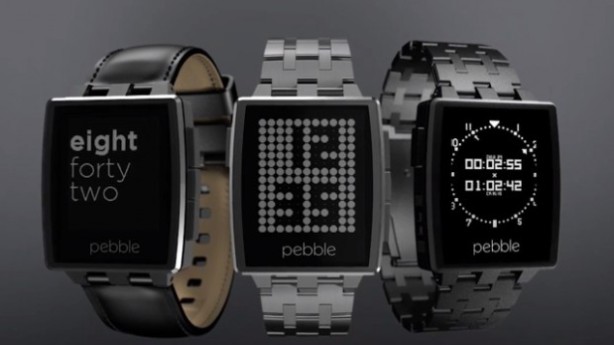
Pebble has unveiled a new premium version of its popular smartwatch.
The Pebble Steel uses, as you’d guess, a stainless steel chassis rather than the plastic of the original Pebble. This is finished with a Gorilla Glass screen covering the e-ink display.
The new model is also rated to 5ATM (50m) and has ‘tactile metal buttons’.
Pebble has also announced it will be launching an app store, providing a single portal for accessing the many existing Pebble apps.
Pebble was one of the earlier successes of Kickstarter, with the original e-ink smartwatch far surpassing its initial investment goal and having gone on to be a successful company.
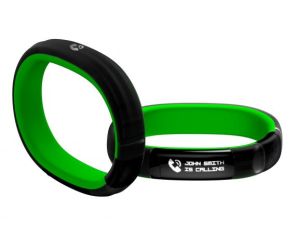
Razer has steadily been diversifying its range of products over the last few years – moving away from its gaming peripheral beginnings – and this year it has taken another big side step announcing the Razer Nabu smartwatch at CES 2014.
The new device is apparently a hybrid of a traditional fitness tracking band, along the lines of a Nike Plus, and the latest tech fad the smartwatch.
“We are calling it a cross between a smartwatch and a fitness band. It’s a wearable device focused on helping you live smarter”, said Razer CEO Min-Liang Tan.
As such its two notification screens – one where a traditional watch face would be and one on the opposite side – can provide wellness data and smartphone notifications.
The larger outer screen is used to show alerts, which you can shake your wrist to dismiss, while the inner display can be used to show more detailed information about incoming calls or other activities.
On the fitness side of things, the Nabu tracks steps walked, distance travelled, and it will monitor your sleep too. Inside is an accelerometer, altimeter and cylindrical vibration motor.
The ability to monitor sleep gives a clue as to this being a slim, lightweight, rubberised device meant to be worn at all times.
It uses Bluetooth 4.0 LE for communication and has a suggested battery life of 7-10hrs – hardly conducive to non-stop wearing – while it is also rated as rain and splash proof.
Available to developers now, the Razer Nabu costs them just $49 (£30) but it is expected to cost more to general consumers when it hits its release date of March.
The standalone version of DayZ was released on Steam Early Access in mid-December.
The standalone version of open-world survival game DayZ is off to a remarkable start, having sold over 800,000 copies in less than three weeks — a figure that far outpaces the amount its developer hoped to sell in the game’s first three months.
In a comment on Reddit, DayZ creator Dean Hall explained what the expectations for the game were and what this outpouring of support means for the game.
“We ([publisher Bohemia Interactive] and I) had very ambitious plans for 2014 already, however this amount of sales was completely unexpected,”
he wrote.
“Honestly, 250k within a quarter was what I would have considered a success. So to move nearly 800,000 in under a month is crazy.
“We’ll be finalizing our roadmap in mid January, but it is safe to say that this kind of result will be having a very positive effect on that roadmap.”
DayZ started out as a mod for PC shooter ArmA II and quickly became incredibly popular. Hall had aspirations of turning the mod into a standalone game from the start, with that project officially being announced in mid-2012. The game has already served as the inspiration for a number of other games — some more so than others — and last month an alpha version was released on Steam as an Early Access game.
In just 12 hours, it had already seen 88,000 downloads and was attracting new player registrations at a rate of 200 per second. Now, less than three weeks later, DayZ is well on its way to one million units sold, and all without the benefit of a Steam sale — the game was routinely among the top sellers on Steam during the Steam Holiday Sale despite not being on sale.
Hall is admirably not shy about cautioning some people away from buying the game at this stage. Games in Early Access can be at many different stages of development, some more complete and playable than others. While DayZ is playable, it’s far from finished. After explaining that buying the alpha now gets you the full version once it’s released, Hall advised one prospective buyer on Reddit,
“I would recommend a very careful and critical review of whether purchasing now is such a good idea. There are many problems which can ruin your gameplay experience. These are being actively fixed – but if you delayed your purchase by a month you would pay the same price but it would be a better experience. Something to consider.”